

Toothpaste tablets are becoming more common in bathrooms, travel kits, hotel amenities, and eco-friendly oral care product lines. As a toothpaste tablet manufacturer, we hear the same questions again and again: What exactly is a toothpaste tablet? Does it work like regular toothpaste? Is it only for zero-waste shoppers? Does it need fluoride?
The simple answer is this: a toothpaste tablet is a dry, pre-measured form of toothpaste that turns into a paste or foam when you chew it and brush with water. Instead of squeezing paste from a tube, you place one tablet in your mouth, crush it lightly with your teeth, wet your toothbrush, and brush as usual. Colgate describes toothpaste tablets as a format where traditional toothpaste has the water removed and is pressed into a small pill-like shape.
From a manufacturing point of view, the idea is not complicated. A toothpaste tablet takes many familiar oral-care ingredients and turns them into a compact solid form. The product looks simple, but the formula still needs to balance cleaning feel, taste, hardness, dissolving speed, moisture control, and packaging stability.
A good toothpaste tablet should feel easy to use, dissolve at the right speed, taste pleasant, and support a normal brushing routine. It should not feel like a novelty product that people try once and then forget.
What Is a Toothpaste Tablet?
A toothpaste tablet, also called a tooth tab, is a small chewable tablet designed for brushing teeth. It is usually made by blending powdered ingredients, flavor, sweetener, cleaning agents, and other functional ingredients, then compressing the mixture into a tablet. When the tablet meets saliva and water, it breaks down and spreads around the teeth.
The biggest difference between toothpaste tablets and traditional toothpaste is water content. Regular toothpaste is already a wet paste. Toothpaste tablets are dry, so they need saliva and a wet toothbrush to activate the brushing experience. This dry format is one reason tablets can be packed in jars, tins, cartons, or refill pouches instead of standard toothpaste tubes.
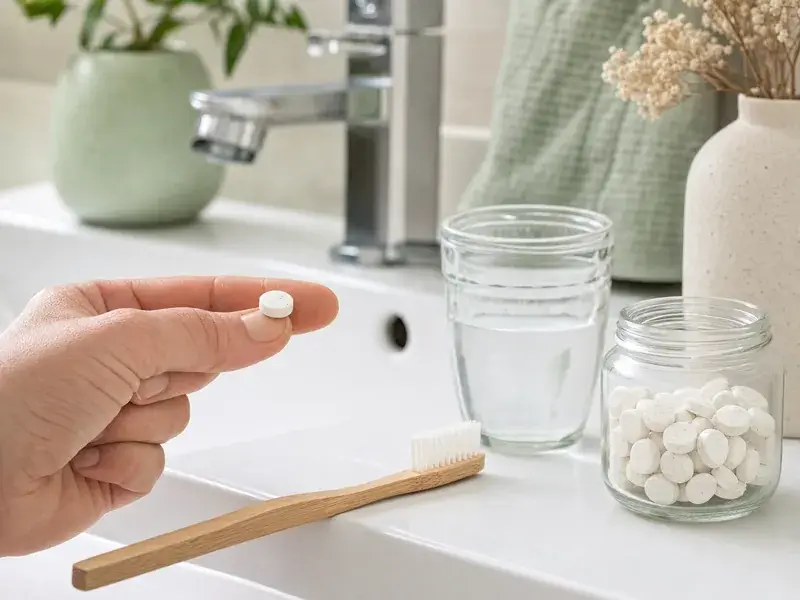
For consumers, the product is easy to understand. For manufacturers, the challenge is making the tablet feel natural. If it is too hard, it may not dissolve well. If it is too soft, it may break during packing or shipping. If it absorbs too much moisture, it may clump in the jar. A well-made tablet has to sit in the middle: firm enough to stay intact, but quick enough to break down during brushing.
| Basic point | What it means in real use |
| Product form | A small dry tablet used instead of squeezing toothpaste from a tube. |
| How it activates | It mixes with saliva and water during brushing. |
| Main purpose | To clean teeth as part of a normal daily brushing routine. |
| Common packaging | Glass jars, aluminum tins, paper cartons, or refill pouches. |
| Best-known benefits | Less mess, easier travel, controlled dosage, and reduced plastic packaging. |
How Do You Use Toothpaste Tablets?
Using toothpaste tablets is simple, but it does feel different the first few times. Place one tablet in your mouth, chew it gently, wet your toothbrush, and brush for two minutes. This general method is consistent with Colgate’s usage guidance for toothpaste tablets.
The key is not to chew the tablet like candy. You only need to crush it enough so it can spread. Once it starts to soften, brush all tooth surfaces the same way you would with regular toothpaste. Some tablets foam a lot; others create a lighter paste. Foam level depends on the formula, not necessarily on cleaning quality.
If the tablet feels a little dry at first, add more water to your toothbrush. If it feels slightly powdery, give it a few more seconds to mix with saliva before brushing fully. These small adjustments usually make the experience much better.
What Is Inside a Toothpaste Tablet?
There is no single formula for every toothpaste tablet. Different brands make different choices depending on the target market, regulations, price level, flavor profile, and whether the product is fluoride or fluoride-free. However, most toothpaste tablets are built around a few familiar ingredient categories.
| Ingredient category | Common role in the formula |
| Cleaning and polishing agents | Help remove plaque and surface stains during brushing. |
| Binders and tablet-forming agents | Help the powder compress into a stable tablet. |
| Foaming agents | Create foam or spreadability, depending on the formula style. |
| Flavor | Gives the tablet a fresh taste, often mint-based. |
| Sweetener | Improves taste without using sugar. |
| Functional ingredients | May include fluoride, hydroxyapatite, xylitol, or other oral-care ingredients depending on the product design. |
As manufacturers, we pay a lot of attention to how these ingredients behave together. A formula may look good on paper but still perform poorly if it crumbles too easily, tastes too strong, dissolves too slowly, or leaves too much residue. That is why tablet development usually includes repeated testing for hardness, moisture stability, mouthfeel, foaming, flavor release, and packaging compatibility.
Do Toothpaste Tablets Work Like Regular Toothpaste?
Toothpaste tablets can support a normal brushing routine, but their performance depends on the formula and how they are used. The tablet shape alone does not make a product better or worse than regular toothpaste. What matters is whether the product contains suitable cleaning ingredients, whether it is used consistently, and whether the user brushes properly.
Fluoride is an important point to understand. The American Dental Association explains that fluoride at recommended levels helps prevent dental caries, and it also notes that toxicity depends on dose. In the toothpaste tablet market, some products contain fluoride and some do not. This is not a small detail. If a customer wants cavity-prevention support similar to many mainstream toothpastes, the label should be checked carefully.
Colgate also points out that there has not been a large amount of research directly comparing toothpaste tablets with traditional toothpaste, and it recommends talking with a dental professional before switching if there are concerns. That is a balanced way to look at the category. Toothpaste tablets are useful and practical, but they should still be chosen with the same care as any other oral-care product.
| Question | Manufacturer’s practical answer |
| Can tablets clean teeth? | Yes, when the formula is well designed and the user brushes correctly. |
| Are all tablets the same? | No. Ingredients, texture, fluoride content, taste, and dissolving speed vary widely. |
| Should I choose fluoride? | If cavity prevention is a priority, consider a fluoride-containing formula and follow dental advice. |
| Does more foam mean better cleaning? | Not always. Foam improves feel and spread, but brushing technique and formula matter more. |
| Can tablets fully replace paste? | They can for many users, but people with specific dental needs should ask a dentist. |
Why Are Toothpaste Tablets Popular?
The first reason is packaging. Many people are trying to reduce plastic in daily products, and toothpaste tubes are not always easy to recycle. Toothpaste tablets are often packed in reusable tins, glass jars, paper cartons, or refill packs, which makes them attractive for low-waste routines.
The second reason is travel. Tablets are dry, light, and easy to portion. A customer can take ten tablets for a five-day trip instead of packing a full tube. They also do not leak inside a bag, which is a small but very real advantage.

The third reason is product experience. A jar of tablets looks clean on the bathroom counter. Each tablet is pre-measured, so there is less product waste. For hotels, airlines, subscription boxes, and private label oral-care brands, tablets also create a fresh product format that feels modern without being difficult to explain.
Toothpaste Tablets vs. Regular Toothpaste
We do not think toothpaste tablets need to be described as a replacement for everyone. Regular toothpaste is familiar, affordable, and widely available. Toothpaste tablets are a different format with different advantages. The best choice depends on the user’s habits, dental needs, and lifestyle.
| Comparison point | Toothpaste tablets | Regular toothpaste |
| Format | Dry, solid, pre-measured tablet. | Wet paste in a tube. |
| First-use feeling | Needs a short adjustment period. | Familiar and immediate. |
| Packaging options | Often refillable, plastic-reduced, or travel-friendly. | Commonly sold in tubes. |
| Travel convenience | Easy to count, pack, and carry. | Can leak and may be treated as a liquid during travel. |
| Formula variety | Fluoride and fluoride-free options are available. | Fluoride options are very common. |
| Cost | Often higher per use, depending on brand and packaging. | Usually lower and widely available. |
For brands and retailers, toothpaste tablets are especially interesting because they fit several trends at once: sustainable packaging, compact shipping, travel convenience, and personal-care innovation. For consumers, the value is more direct: cleaner storage, less mess, and a product that feels simple once they get used to it.
Common Questions About Toothpaste Tablets
Are toothpaste tablets the same as toothpaste?
They serve the same daily brushing purpose, but they are not physically the same. Traditional toothpaste is a ready-made paste with water already in the formula. A toothpaste tablet is dry and becomes paste-like when it mixes with saliva and water. In simple terms, it is toothpaste in a solid format.
Do toothpaste tablets contain fluoride?
Some do, and some do not. This is one of the first things customers should check. Fluoride is widely used in oral care because it helps protect teeth against decay when used at recommended levels. If fluoride is important to you or your customers, choose a formula that clearly lists it on the label.
Are fluoride-free toothpaste tablets useless?
No, that would be too simple. Fluoride-free tablets may still help with brushing, freshness, and plaque removal when used properly. However, if the goal is cavity-prevention support, fluoride is a major ingredient to consider. The right choice depends on personal preference, market regulations, and dental guidance.
Why do some toothpaste tablets feel chalky?
A toothpaste tablet starts as compressed powder, so texture is part of the product design. A slightly powdery feel can happen if the tablet dissolves slowly, if the user brushes too quickly, or if the formula uses certain polishing agents. Good formulation can reduce this issue by improving dissolving speed, particle feel, and flavor balance.
Do toothpaste tablets foam?
Many do, but not all. Some consumers expect strong foam because they are used to regular toothpaste. Others prefer low-foam formulas. Foam can make brushing feel more familiar, but it is not the only sign of a good product.
Are toothpaste tablets safe for children?
Children’s oral care should be handled carefully because young children may swallow toothpaste or mistake tablets for candy. The American Academy of Pediatrics recommends age-appropriate amounts of fluoride toothpaste for children, which shows why dosage and supervision matter. For children, parents should follow professional dental guidance and keep tablets out of reach when not in use.
Can toothpaste tablets be swallowed?
They are designed for brushing, not eating. Like regular toothpaste, a small accidental amount may be swallowed during brushing, but users should spit after brushing unless the product instructions say otherwise. Tablets should also be stored safely away from children and pets.
Do toothpaste tablets expire?
Yes. Dry products may be stable for a long time, but they still need proper storage. Moisture, heat, and poor sealing can affect tablet hardness, flavor, and performance. From a manufacturing and packaging perspective, moisture control is one of the most important parts of making a good tablet product.
Are toothpaste tablets good for travel?
Yes, travel is one of their strongest advantages. They are compact, dry, easy to count, and unlikely to leak. This makes them useful for personal travel, hotel amenities, camping, gym bags, and airline-friendly toiletry kits.
Are toothpaste tablets more eco-friendly?
They can be, especially when they reduce plastic packaging and use refill systems. However, sustainability should be judged by the full product, not just the word “tablet.” Packaging material, refill design, shipping weight, production quality, and how consistently people use the product all matter.
What Makes a Good Toothpaste Tablet?
A good toothpaste tablet should not only look nice in a jar. It should perform well in daily use. From our perspective as a manufacturer, the best formulas are the ones that make the customer forget they are using something “new” after a few days. The tablet should dissolve smoothly, taste fresh, brush comfortably, and stay stable until the last piece in the container.
| Quality factor | Why it matters |
| Tablet hardness | Prevents breakage during packing, shipping, and storage. |
| Dissolving speed | Affects how quickly the tablet turns into a brushable paste. |
| Mouthfeel | Determines whether the tablet feels smooth, gritty, creamy, or chalky. |
| Flavor release | Makes the brushing experience pleasant without being too strong. |
| Moisture resistance | Helps prevent clumping, softening, or loss of tablet shape. |
| Packaging compatibility | Protects the tablets and supports the brand’s sustainability goals. |
This is also why private label toothpaste tablets should not be chosen only by appearance. Two tablets may look almost identical but feel completely different when used. For brand owners, sample testing is important. For consumers, reviews about texture, foam, and taste are often more useful than packaging photos alone.
Final Thoughts from a Toothpaste Tablet Manufacturer
Toothpaste tablets are not just a trend, and they are not just “toothpaste without a tube.” They are a practical oral-care format that solves several real problems: plastic packaging, travel mess, product waste, and bathroom clutter. At the same time, they still need to meet the basic expectations people have for toothpaste: clean feel, fresh breath, comfortable brushing, and reliable daily use.
If you are a consumer, start with a small pack and pay attention to the ingredient list, especially if you want fluoride. If you are a brand owner, focus on formula quality before packaging design. A beautiful jar may get the first purchase, but a smooth, pleasant, well-made tablet is what gets the second one.


